Categories
Gin

Twisted Nose

Doubling down on the pepperiness.

Twisted Nose is from the Winchester distillery, on the edge of the South Downs. In the beforetimes, when it was still possible for a chap to visit a university chum to celebrate a birthday, your Middle Class Reviewer took an entertaining trip to Winchester and enjoyed a couple of White Lady cocktails in an underground nightspot. Twisted Nose would most certainly not fit into a White Lady. The bottle proclaims the stand-out botantical to be watercress, and there is a certain zing of pepperiness to it. However, this is mellowed out by lavender, giving it a rather full-bodied mouth feel.

On the second night of drinking the stuff, it seemed necessary to bring out more of this zing. One does not often recommend more than a single garnish for a gin and tonic, however in the case of the Twisted Nose it is possible to drastically enhance the character of the drink, to kick-start what’s perhaps a little too subtle and bolster the flavour profile. Radishes are not something one usually associates with a gin & tonic, however they do have a really punchy taste and can easily be utilised to accentuate the flavour of a gin. Most of the flavour in a radish is in its skin, so if you’re feeling really ambitious, take a thin shaving and spiral it around in the glass. A couple of peppercorns are welcomed in almost any gin and tonic – the nucleation of carbon dioxide from the tonic will give the drinker both an extra kicker of warmth and a side-show. As the bubbles form on the peppercorns, they float up to the surface. As the bubbles pop, the corns sink again to the bottom of the glass to start the entertaining ballet all over again. Trying the Twisted Nose with just these, however, left me wanting. The lavender was still a little too present. The final addition of a star anise fruit won the day. Floating around in there, it rounds off the profile wonderfully. Twisted Nose is a good gin. If the distillers were a little bolder and made the botanicals more present, this would be a great gin.

If one were to experiment with other drinks using Twisted Nose, a great starting point may be a Gin-Gin Mule. Avoid anything that needs citrus, as there is simply none apparent.

Middle-class meal accompaniment? It would go very well, again, with something to bolster its flavour profile. A rocket salad would do splendidly, with charred chicken, croutons baked in olive oil and marjoram and a well-aged Balsamic vinaigrette.

Categories
Gin

Mermaid Gin

Nothing middle about the class of this bottle.

Over the past couple of years, this Middle Class Reviewer has spent a not inconsiderable amount of time in Portsmouth and Southsea. The highlight of his time there was undoubtedly Huis, the little Belgian bar/restaurant on Elm Grove in Southsea. Those delightful chaps consistently have bellypork on the menu, and manage to cook it in a way that sparks joy. Each fennel seed-studded mouthful is an orgy on the tongue where everyone comes together in a climax of porky bliss.

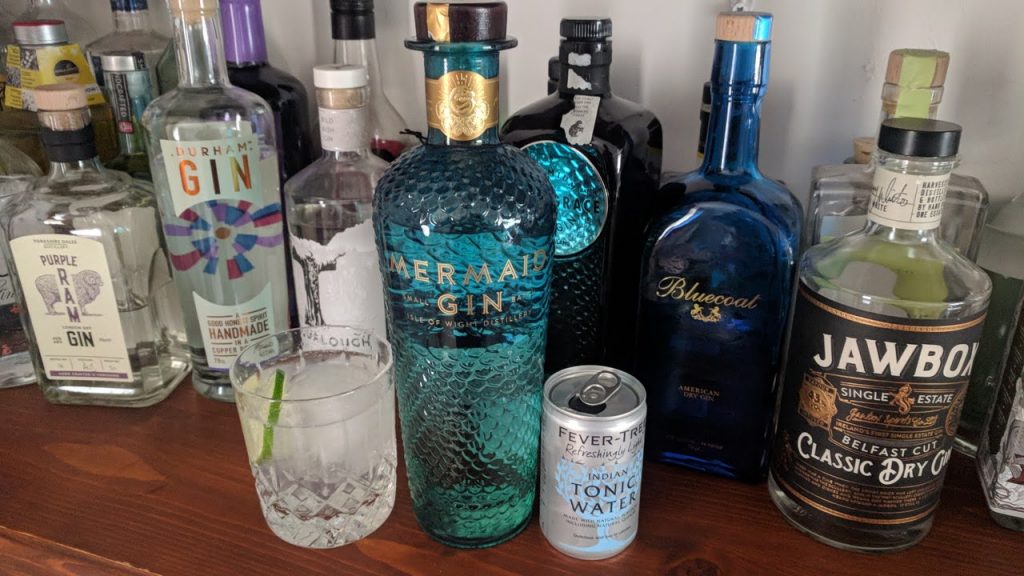
Portsea Island is a gateway to the Isle of Wight, sitting closer to the mainland on the north side of the Solent. Despite being considerably larger than Portsea, the Isle of Wight it has a only 3/4 of Portsea’s population. Numbers may not be the be-all and end-all, though, because the Isle of Wight is home to Mermaid Gin. Named for “Mermaid’s Kiss”, a common name for rock samphire which grows in abundance around the shoreline on the isle, this gin comes in a bottle that can only be described as exquisite. The packaging won the Design Award in the International Wines and Spirits Category in 2019, and that award was absolutely justified. The bottle is stunning. The glass conjures images of fish-scale, managing to be perfectly proportioned as a bottle on the shelf while remaining distinctive in pattern and colour. The packaging is entirely plastic-free, with the tamper seal being a biodegradable plant-based “thingummy” which will, undoubtedly, offset the frankly obscene carbon cost accrued over the past couple of years by flying to Southampton Airport to get to the south coast .

The packaging usually is a frippery. Admittedly, it was instrumental to the purchase of a bottle at the airport Duty Free, but having tasted the stuff, it is still to going be the main spur to buy more.

The gin itself is pretty good, being a dry, clean tasting gin. There is a subtlety of flavour there, with the botanicals amusing the palate with gentle hints of citrus and a suggestion that maybe there’s a bit of peppery spice lurking in there, waiting to be teased out. Mermaid Gin is a premium-brand gin for the unadventurous. There is no bold challenge to wrestle with. It does not fight for your attention. It contentedly and gracefully provides a rather good gin & tonic. Having Mermaid in one’s collection is almost a must, given the sheer beauty of the bottle. As a gin, it is a better-than-average standard spirit that doesn’t go far wrong. Were it in another bottle, it wouldn’t blow anyone’s socks off. Packaged as it is, though, it deserves a place in your collection.

Middle-Classossity: Design Award.

Middle-Class accompaniment: Someone to gaze appreciatively at the bottle with.

Categories
Gin

Longtooth Gin

Longtooth is the re-imagining of what was apparently a very popular brand in the UK in the 1960s and ’70s – Bengal Gin (pictured below)

_0002_Bengal Paws.jpg
Nothing says sophistication like a chemically mollified tiger

Bengal Distilleries started as a continuation of an illicit still tacked on to a chemical works producing alum, a flocculent, in Konnagar in the Bengal region of India. The distillery became rather well-established and produced brandy and gin as well as its cheap, molasses-based Arak. Its owner, one Eric Hayward, was a rather enthusiastic Anglo-Indian businessman, holding licences for the distribution of opium, marijuana and hard liquor in India before such good things became frowned upon. Hayward sold Bengal Distillery to the Shaw-Wallace company in 1958, where under the stewardship of his son, Tony, Bengal Gin became the drink of choice for swinging 60’s Britain. Longtooth’s revival of the spirit stems from 2018, when a “secret” master distiller dusted off a recipe and came up with Longtooth. The Longtooth website declares their signature pour to be the Maneater Martini, and being a middle-class reviewer comfortable with the concept of drinking a gin called The Maneater, this had to be the pour to score.

It is a silly drink

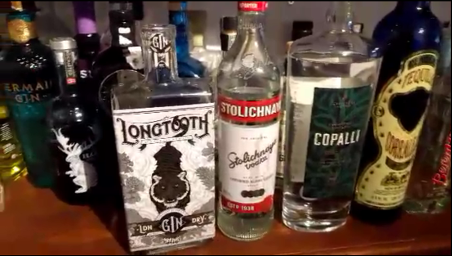
The ingredients for a Maneater Martini are:

  • 1 part Longtooth Gin
  • 1 part Copalli white rum.
  • 1 part Stolichnaya vodka.
  • 1 part Corralejo Reposado Tequila.
  • 2 parts Berentzen peach schnapps.

This is enhanced in the most delightful way by the addition of a couple of shakes of orange bitters. Regan’s No. 6 works superbly, however other varieties may do just as well.

There is little fancy about the making of this cocktail. No elaborate shakes in a copper shaker on ice. Simply pour in the ingredients and give it a good stir. It should be admitted that, being totally unfamiliar with peach schnapps (it had to be ordered in specially for this review) your middle class reviewer made “a bit of a boob” with the first pour, mistaking the pink lacing pattern on a bottle of La Caravedo pisco for the sort of thing one would usually expect on a bottle of peach schnapps. The result of this mishap was somewhat over half a pint of hard liquor, a “Maneater Plus”. Surprisingly, the Maneater not was overwhelmed with the addition of pisco and the cocktail was eminently drinkable. Needless to say though, it would not do to base the review of Longtooth’s signature pour on the basis of an improperly made version, so once the Maneater Plus had been consumed, your reviewer was able to mix a standard Maneater for the purposes of review.

It should be noted at this point that there was absolutely the intention to write a review following the second Maneater.

The ingredients list looks – and we should be honest in our assessment here – revolting. Tequila. Peach schnapps. Vodka. White rum. The phrase “overkill” looms ominously into view when deciding whether one should mix a Maneater. However, the drink works. The second was undoubtedly better than the first. However, after the second, memory becomes a little hazy. A third was absolutely out of the question, however the bottle of pisco had been left within an arm’s reach and it seemed like a very good idea to drink more. Suffice to say, “bed” as a destination was not reached that night, and your reviewer found himself at around 04:45 waking up on the settee, thankfully fully clothed – and in full control of his bladder. The resulting hangover was fearsome. Needless to say, a review was not written.

Tonight marks attempt number 2 at a Maneater review, and at the start of this paragraph approximately 2/3rds has been consumed. It genuinely is a remarkably good drink. Longtooth works well in it; spicy but not overwhelming. The tequila must be selected carefully; Jose Cuervo should not be allowed within twenty leagues of <anything at all> and the orange bitters does very well to add a frisson of excitement to proceedings.

Longtooth itself is most certainly worth a look. The branding is superb, the botanical mix is invigorating and compelling, and 10% of profits are ploughed into big cat charities, which is always a nice sop to the middle-class guilt of whether one does enough for the natural world or not.

Categories
Gin

Bertha’s Revenge

From the Emerald Isle, this gin has quite a story attached to it. Unusually for a small batch gin, the distillation uses milk whey alcohol, rather than potato or grain. With this in mind, the distillers attempt to capture the verve of Bertha in the gin. Bertha is a Guinness World Record holder, reaching the delightful old age of 48. She must have been a well-tempered beast, because the spirit captured in the, er, spirit is quite extraordinary.

Your humble Middle-Class Reviewer has tried milk whey spirits before. Almost universally they are repulsive, thick affairs with the consistency of saliva, however Bertha’s Revenge manages to be none of these things. There is a hint of the buttery texture that one might associate with a Chardonnay rich with Diacetyl, however not even the smallest hint of butter to the tastebuds. What one does experience, however, is the gentle caress of the botanicals. Well, botanicals may be an overemphasis on the plural, because really what one experiences on the sip is cardamom. This is not necessarily a bad thing. The gin makes something of it; unlike certain other cardamom-heavy gins (Ophir, you’ve been naughty) this is almost entirely unlike drinking a Biryani. The spice compliments and enriches the alcohol in a way that is terribly pleasing to the taste buds. The finish to this gin has a distinct pepperiness that distracts and distances from the initial cardamom taste, balancing out on the tongue with aplomb.

To appreciate this gin, one should really pick a sharper garnish. Tonight, a frozen blackberry and a couple of razor-thin shavings of pear were selected. Whilst this fruity accompaniment was not unpleasant, one cannot help but feel that something a little sharper would be more fitting. Citrus, for sure. Not lemon or lime though. Perhaps a slice of bergamot, or perhaps even a few shaving of lemongrass would better compliment this mix. For the second glass, a sprig of Holy Basil and a just half a leaf of spearmint have added a frisson of colour to proceedings.

For a G&T, the spectre of “aromatic” tonic waters may rear its ugly and unsophisticated head. One could imagine there being some place for such monstrosities; Bertha was after all several hundred kilos of beef and her namesake can easily bring that mass to bear on a more offensive tonic. As for cocktails – well. Your reviewer is running towards the end of his bottle and frankly doesn’t wish to risk the remainder on experiments, because it works rather splendidly in a G&T.

Middle-Classness Factor: Milk-whey gin from another country named after a record-breaking cow.

Taste Factor: Medium rare.

Middle-Class Meal accompaniment: Not a Biryani.

Middle-Class Collectability: Yes. Buy a bottle.

Categories
Gin

Harahorn Gin

Harahorn small batch Norwegian gin.
Harahorn. A hare. With horns.

The middle class reviewer quite likes the Norwegians. These Scandinavian types are usually quite fun, with their progressive politics and affluent lifestyles a mere veneer over a history of Viking rapine and pillage. This facade of civility is demolished, utterly, when boarding the Københavner-båten, where scandis flock to buy cheap alcohol from Copenhagen. Boarding the ferry to neighbouring Denmark is the modern day equivalent of a longboat raid as Norwegians svelte and stout sally forth to stock up on beer.

Harahorn gin, similarly, strips away any pretense and leaves exposed the truth of Norwegians, which is that they use snus, plodge around in temperatures of – 40C and lower without a care for it, and they literally invented the word “Berserk”. For all their hardy determination, they are a wonderful people, and only they could have made Harahorn Gin.

Harahorn is unafraid to announce itself. Bold flavour is the order of business here. On the first taste, the tartness of the rhubarb was perilously close to being mistaken for a slightly tails-heavy cut. A second, indeed third round quickly dispels that notion and reminds you that gin does not have to be delicate. It is not, however, a knock-out. There are subtleties to be discovered if sought. The initial aggression is by no means the final word. There is fun packed into the finish, which holds long on the tongue and breathes a truly delightful olfactory tease on the exhale.

This gin is unlikely to appeal to the summer drinker, who chases a light, refreshing mix of botanicals. For those who like a gin that is unashamedly present in the drinking, that could act as the warm-up fight for its departed cousin Brennevin, then the middle class reviewer would be remiss to not recommend it.

The middle class meal accompaniment would not be the crass stereotype of elk blood sausage or any form of fermented or dried fish. Oh no. This would go very splendidly with a game bird; pigeon for preference, or pheasant at a push.

Middle class rating? A Tesla Model 3.

Categories
Gin

Jinzu

Your middle-class reviewer has taken it upon himself this evening to step away from the London Dry and mix himself up a Gibson using a composite blended gin from Scotchland. It may be made in a factory and it may not be a London Dry, but it definitely deserves a place in the gin collection. Made with some unknown ratio of an industrial-processed gin and a distilled saké, it’s the incomparable smoothness of the saké that makes this. Having sampled Jinzu some years previously in a gin bar somewhere in the hometown of an entirely unsuitable young lady, your reviewer was aware that it had some different qualities and didn’t hesitate in his purchase of a full bottle. Partly from nostalgic reminiscence (perhaps she wasn’t that unsuitable) and partly for a magpie-like need to have the shiny bottle in his collection, Jinzu naturally now graces the middle-class gin shelf and blesses it with its simple, Japanese-inspired design. Make no mistakes, this gin is no more Japanese than Rob Roy, yet the saké nods to the Land of the Rising Sun, and an enthusiastic nod it is.

Coupled with the suggestion that some vermouth may make an appearance at some point (a wetter ratio than 5:1 is beyond comprehension) the Gibson it makes is so smooth as to fool the palate into thinking that one isn’t actually drinking it, more slowly realising that it’s already there in the mouth. All one has to do is allow it to languish there for a while before permitting it to somehow arrive in the bloodstream without any suggestion that it has been swallowed. Silken is not adequate to describe it and this is the absolutely incontrovertible secondary reason why the Martini mixed with Jinzu should be a Gibson.

There is a sharpness to be had from a pickled silverskin onion which counterpoints and accentuates the mellifluous velvet of the drink. The crispness of the onions, the sharp suggestion of vinegar, the comfortable crunch as they are devoured – every part of this combination screams out in a crescendo of ecstasy, cementing the runner-up reason why one should favour the Gibson. The primary factor is, of course, that olives are the Devil’s gonads. This usually stands a thousand leagues ahead of any other justification one may have for selecting a garnish, however in  the case of Jinzu its lead is only very slight, such is the winning combination of smooth and sharp.

Domo arigato tha noo, Jinzu.

Categories
Gin

Purple Ram


Posted on 12th February, 2020

From the Yorkshire Dales, this gin has sat unopened in the collection for quite some time. Having promised to review it last week, the middle class reviewer was instead distracted by games of squash, delayed flights and various other trivialities that have no relation to you – dear reader – or your happy, middle-class lives. You may be entertained to find out that one of your reviewer’s chums knocked a damn-near full White Lady over on him in a rather delightful underground nightspot in the South Downs. You might be titillated by the knowledge that lunch on Sunday was an entertaining sweet potato frittata served with a green lentil and chantenay carrot salad. The expectation, however, must be that none of this is of the least consequence and that other middle-class reviews will be read if the subject of Purple Ram is not addressed forthwith.

The bouquet of this gin is as intoxicating as the liquor is meant to be. Lacking somewhat in the intense juniper hit of many small-batch gins, this gin genuinely rewards the nose with a honeyed aroma. Sure enough, the label proclaims that a local artisan honey is used in the production, which makes this a winner for “spot the botanicals”. The honey comes through in the taste too, and it’s delightful. This does lead to a slightly sweeter gin and this should be compensated for in the selection of your garnish.

This evening, the pairing of grapefruit and lemongrass complemented the sweetness and lent a dash of tartness; a perfect retort. In a slight deviation from the usual order of affairs, the middle class meal accompaniment was chosen yesterday; long before the gin was selected and match-paired. Khorak Morgh (a saffroned chicken stew popular in Persian cooking) really benefits from an overnight to let the flavours develop fully. Instead of rice or flatbreads though, it was served on bed of purple sprouting broccoli, kale and spinach. Yes, time catches up even with those pickled in gin and cruciferous vegetables become ever more eiderdown-floatingly present in the diet. Drinking a Purple Ram gin and tonic with this dish was… ill advised. While the delicate fragrance of the saffron did no harm at all to the gin, the same cannot be said of the reverse pairing. A second G&T was mixed a safe time after finishing the food and, free from the distraction of Iranian cuisine, your reviewer was able to finally get stuck in. This is a subtle, well-balanced gin with a delightfully complete palate. The honey tickles the roof of the mouth while the citrus dances playfully on tip of the tongue. It is smooth, rewarding a 60:40 gin:tonic ratio handsomely. One could easily imagine donning a raincoat and trilby then meeting Terry Lennox at Victor’s for gimlets made with this stuff.

Middle class verdict? Purple Ram has just butted its way into regular rotation. Splendid.

Categories
Gin

Hampstead London Dry


Very shortly after announcing yesterday that the middle-class reviewer was willing to take requests for gin reviews, the suggestion arrived for a dirt-cheap gin from one of the European discounters.

Needless to say, when it comes to own-brand things, the middle-class reviewer is more familiar with Waitrose and M&S than he is with Lidl, however given that the request was made, he ventured into Lidl and purchased a half litre of this stuff for the princely sum of £9.99. Opening the bottle this evening with some trepidation, a light sniff was afforded, with the expectation of nasal passages melting like the unfortunate glaciers that I’m sure other people will manage to do something about one of these days.

Knowing something about the production of gin, and perhaps more importantly the operation of the taxman, it is hard to imagine how Lidl can make anything beyond paintstripper when a half litre weighs in at less than a tenner. However. They have somehow managed to make something that actually is half decent. It is by no means a terrible as one has every right to imagine it would be. Far from being a paint stripper, it instead outstrips the mainstays of mass-produced British gin, being slightly above par when compared to Gordon’s and leagues beyond Beefeater.

As we’ve learned from Hendrick’s, cucumber is a bad garnish for gin. What is mild and refreshing in a crustless, lightly buttered sandwich becomes a nuclear blast in a gin & tonic, obliterating all but the most aggressive of botanicals from our spirit, and honestly, your reviewer regrets his choice of garnish for this gin. Given the price point, this drink is quite a revelation. Whilst it is unlikely to find its way into regular rotation at Chez MC, it is certainly not a gin that one would feel guilty about if it were served to a guest that one actually likes following a dinner party.

The next serve will not be with the bellicose butcher of botanicals that is cucumber; instead this citrusy surprise will be coupled with a more genteel, generious garnish. A thin slice of pear I think should compliment both the drink and the meal to go with it. Tonight’s middle-class meal will be slow-roasted belly pork spiked with fennel seed, accompanied by buttered new potatoes, garlic and basil sauté kale and, of course, roasted slices of pear.

Categories
Gin

Dorothy Parker

New York Distilling Company

Reviewed 24 Jan 2020

Dorothy Parker

“That would be a good thing for them to cut on my tombstone: Wherever she went, including here, it was against her better judgment.”

Dorothy Parker was a New York wit, a writer and – unfortunately – a poet. The gin distilled for her name has been put together by the New York Distilling Company and, while I have had the bottle for a while now and enjoyed it, is another of those that has been largely out of rotation precisely because I like it so damn much. On picking a gin to review this evening, it became the first gin to receive a middle class review purely on the basis of colour-matching with my choice of garnish. I’d filled my glass with ice and loaded in a couple of slices of purple plum before I’d even retired to the gin collection, and when I caught glimpse of the heavily stylised stencil art on the back label, the identical colours made my mind up for me. 

This gin is held high in my regard. Curiously, the New York Distilling Company also makes easily the worst gin ever to disgrace a juniper berry; the aptly named Chief Gowanus. I appreciate that Gowanus is an indigenous American of some history, however the connotations of Gowanus are very much more peurile, in that the suggestion of where one should go is actually infinitely preferable to the thought of having to drink that gin again.

I digress, however. Dorothy Parker gin is superb. A floral, almost fruity gin, it has taken on a lovely pink hue from the plum and remains, to the last mouthfuls, as delicate and deceptive as the first drops. It makes a remarkably good gin & tonic, and indeed this would be my preferred serve. It lacks the punch needed for a good dry Martini. A gimlet would swallow it whole.

Middle-class meal accompaniment? Crêpes Suzette.

Categories
Gin

Scapegrace

First Reviewed 12 Jan 2018

I have held off reviewing Scapegrace for some little while now, mainly because I’ve been too busy drinking the stuff. As regular readers of my Middle Class reviews ought to know, I enjoy a bit of variety in my tipples, however this one really hits the spot.

This gin comes from New Zealand. I don’t know how many of my readers have been to New Zealand, but it is really in large parts very much like Great Britain, except with the dials turned up to 11. The hills are somehow hillier. The green pastureland both greener, yet also somehow pasturelandier

The antipodean fellows who distil Scapegrace have managed to apply the same concept to their gin, taking a wonderfully British drink and managing to boost the volume of it. There is no standout botanical in Scapegrace. No gimmicky theme to overwhelm the senses. It’s just a London Dry that does London Dry in the same way Spinal Tap does amps.

Apparently, this stuff has won gongs for being a Jolly Good gin and this Middle-Class Reviewer has to concur with the judges; it is an exceptional spirit.

Saying all this. I am aware that it is a contentious gin. A chap of my acquaintance described it as “revolting” and scoffed at my lyrical waxing. As far as I am concerned, this young blade is more than welcome to not enjoy it, as it will leave all the more for me to enjoy.

Middle class verdict:

Pretentiousness: 6/10

Gin-miles: 10/10

Gushingly effusive one-upmanship potential: 7/10

The potential for gushing effusiveness is brought down by the fact it’s won gongs. Fortunately, I discovered it before all that, which restores my personal middle-classosity to the full 10/10.

Middle-class meal accompaniment

More of the same please. Until I pass out in a pleasant stupor of really very excellent gin.